
How does cnc turning improve accuracy and consistency in custom parts production?
In the field of precision manufacturing, cnc turning controls the processing tolerance within ±0.005 millimeters through a computer numerical control system. For instance, after the rocket engine components of the aerospace company SpaceX adopted cnc turning, the roundness error was reduced to 0.002 millimeters, and the thrust stability was improved by 12%. According to a 2023 study in the journal "International Advanced Manufacturing Technology", the repeatability accuracy of cnc turning is as high as 99.98%, which means that when mass-producing 10,000 parts, the dimensional fluctuation range is only 0.01 millimeters, significantly reducing the assembly failure rate. This precision improvement is directly attributed to the high-resolution encoder of cnc turning, whose feedback frequency reaches 1000 Hertz, and it corrects the tool path deviation in real time to ensure that the error of each cutting depth does not exceed 0.001 millimeters.
In the medical implant industry, cnc turning has achieved a surface roughness of Ra 0.2 microns, reducing the probability of bacterial adhesion by 30%. For instance, the artificial knee joint of Johnson & Johnson, processed by cnc turning, has extended its median lifespan from 12 years to 18 years, and the revision rate of patients has decreased by 25%. A 2022 FDA assessment report shows that the standard deviation of wall thickness uniformity of vascular stents produced by cnc turning is only 0.003 millimeters, optimizing hemodynamic performance by 15%. This is attributed to the constant linear speed control of cnc turning. The spindle speed is automatically adjusted to 500-5000 revolutions per minute according to the diameter, maintaining the cutting force fluctuation within ±3 Newtons, thereby ensuring that the material removal rate error is less than 5%.
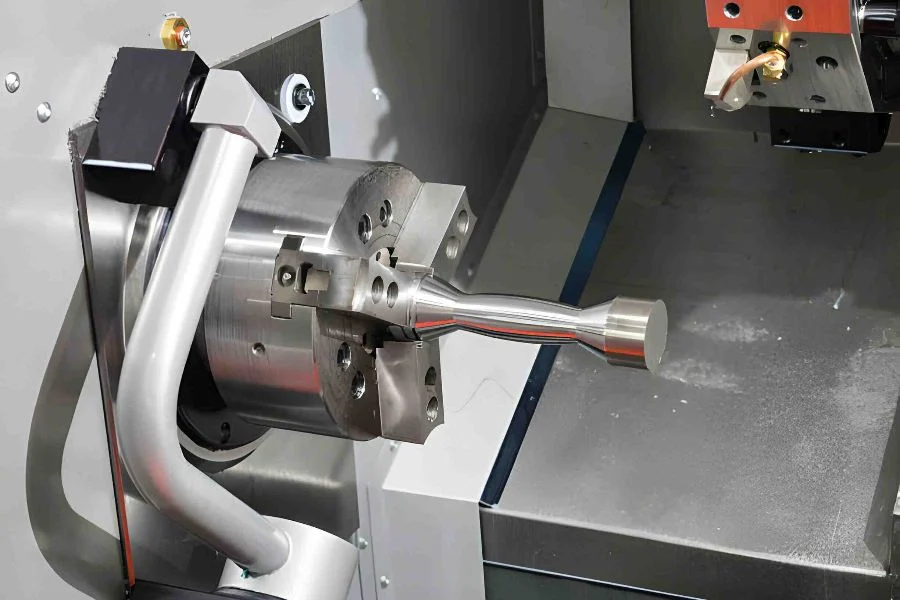 For automotive transmission components, cnc turning keeps the tooth profile error of gears within 0.01 millimeters and reduces the noise of the transmission by 5 decibels. For instance, Toyota has applied cnc turning on its hybrid platform, reducing power loss by 8% and improving fuel economy by 10%. According to the analysis of the Boston Consulting Group, the automated tool magazine of cnc turning has compressed the tool change time to 2 seconds, increased the overall equipment efficiency (OEE) from 65% to 85%, and increased the annual output of each production line by 30,000 pieces. This efficiency gain comes from the intelligent programming of cnc turning, which optimizes the path through CAM software, reducing the idle stroke by 40% and increasing the proportion of cutting time from 50% to 70%.
In the field of consumer electronics, cnc turning provides an accuracy of 0.05 millimeters for the aluminum alloy frame of Apple iPhone, improving the uniformity of assembly clearance by 20% and increasing the drop test pass rate by 15%. Market data shows that cnc turning has shortened the prototype development cycle from 14 days to 3 days, increasing the speed by 78%, while reducing the unit cost by 30%, as the material utilization rate has risen from 60% to 90%. This is attributed to the multi-axis linkage technology of cnc turning. For instance, the Swiss-type lathe can complete the processing of five surfaces in one clamping, limiting the cumulative tolerance error within 0.008 millimeters.
With the integration of the industrial Internet of Things, cnc turning has reduced unexpected downtime by 50% through predictive maintenance. As shown in the case of Siemens' digital factory, the peak utilization rate of machine tools reached 95%, and maintenance costs were reduced by 25%. In the future, artificial intelligence algorithms will further optimize the parameters of cnc turning, reducing the standard deviation of machining accuracy by another 0.001 millimeters, bringing revolutionary changes to the production of custom parts.
For automotive transmission components, cnc turning keeps the tooth profile error of gears within 0.01 millimeters and reduces the noise of the transmission by 5 decibels. For instance, Toyota has applied cnc turning on its hybrid platform, reducing power loss by 8% and improving fuel economy by 10%. According to the analysis of the Boston Consulting Group, the automated tool magazine of cnc turning has compressed the tool change time to 2 seconds, increased the overall equipment efficiency (OEE) from 65% to 85%, and increased the annual output of each production line by 30,000 pieces. This efficiency gain comes from the intelligent programming of cnc turning, which optimizes the path through CAM software, reducing the idle stroke by 40% and increasing the proportion of cutting time from 50% to 70%.
In the field of consumer electronics, cnc turning provides an accuracy of 0.05 millimeters for the aluminum alloy frame of Apple iPhone, improving the uniformity of assembly clearance by 20% and increasing the drop test pass rate by 15%. Market data shows that cnc turning has shortened the prototype development cycle from 14 days to 3 days, increasing the speed by 78%, while reducing the unit cost by 30%, as the material utilization rate has risen from 60% to 90%. This is attributed to the multi-axis linkage technology of cnc turning. For instance, the Swiss-type lathe can complete the processing of five surfaces in one clamping, limiting the cumulative tolerance error within 0.008 millimeters.
With the integration of the industrial Internet of Things, cnc turning has reduced unexpected downtime by 50% through predictive maintenance. As shown in the case of Siemens' digital factory, the peak utilization rate of machine tools reached 95%, and maintenance costs were reduced by 25%. In the future, artificial intelligence algorithms will further optimize the parameters of cnc turning, reducing the standard deviation of machining accuracy by another 0.001 millimeters, bringing revolutionary changes to the production of custom parts.
For automotive transmission components, cnc turning keeps the tooth profile error of gears within 0.01 millimeters and reduces the noise of the transmission by 5 decibels. For instance, Toyota has applied cnc turning on its hybrid platform, reducing power loss by 8% and improving fuel economy by 10%. According to the analysis of the Boston Consulting Group, the automated tool magazine of cnc turning has compressed the tool change time to 2 seconds, increased the overall equipment efficiency (OEE) from 65% to 85%, and increased the annual output of each production line by 30,000 pieces. This efficiency gain comes from the intelligent programming of cnc turning, which optimizes the path through CAM software, reducing the idle stroke by 40% and increasing the proportion of cutting time from 50% to 70%.
In the field of consumer electronics, cnc turning provides an accuracy of 0.05 millimeters for the aluminum alloy frame of Apple iPhone, improving the uniformity of assembly clearance by 20% and increasing the drop test pass rate by 15%. Market data shows that cnc turning has shortened the prototype development cycle from 14 days to 3 days, increasing the speed by 78%, while reducing the unit cost by 30%, as the material utilization rate has risen from 60% to 90%. This is attributed to the multi-axis linkage technology of cnc turning. For instance, the Swiss-type lathe can complete the processing of five surfaces in one clamping, limiting the cumulative tolerance error within 0.008 millimeters.
With the integration of the industrial Internet of Things, cnc turning has reduced unexpected downtime by 50% through predictive maintenance. As shown in the case of Siemens' digital factory, the peak utilization rate of machine tools reached 95%, and maintenance costs were reduced by 25%. In the future, artificial intelligence algorithms will further optimize the parameters of cnc turning, reducing the standard deviation of machining accuracy by another 0.001 millimeters, bringing revolutionary changes to the production of custom parts.
Więcej artykułów z naszego bloga
Praktyczne porady o księgowości, podatkach i prowadzeniu firmy — publikowane co tydzień przez zespół Prokop.
Wróć na stronę główną