
Auditing a Fragrance Factory for an EU Launch, Step by Step
Auditing a fragrance factory for an EU launch works best as a sequence with gates, each gate producing a written decision before you spend the next increment of money or time. Seven steps, product definition, compliance screening, desk review, plant visit, sample evaluation, pilot order and EU paperwork, keep the process cheap to abandon early and cheap to scale late. Most failed audits fail at step two, because the product was never defined closely enough to be checked.
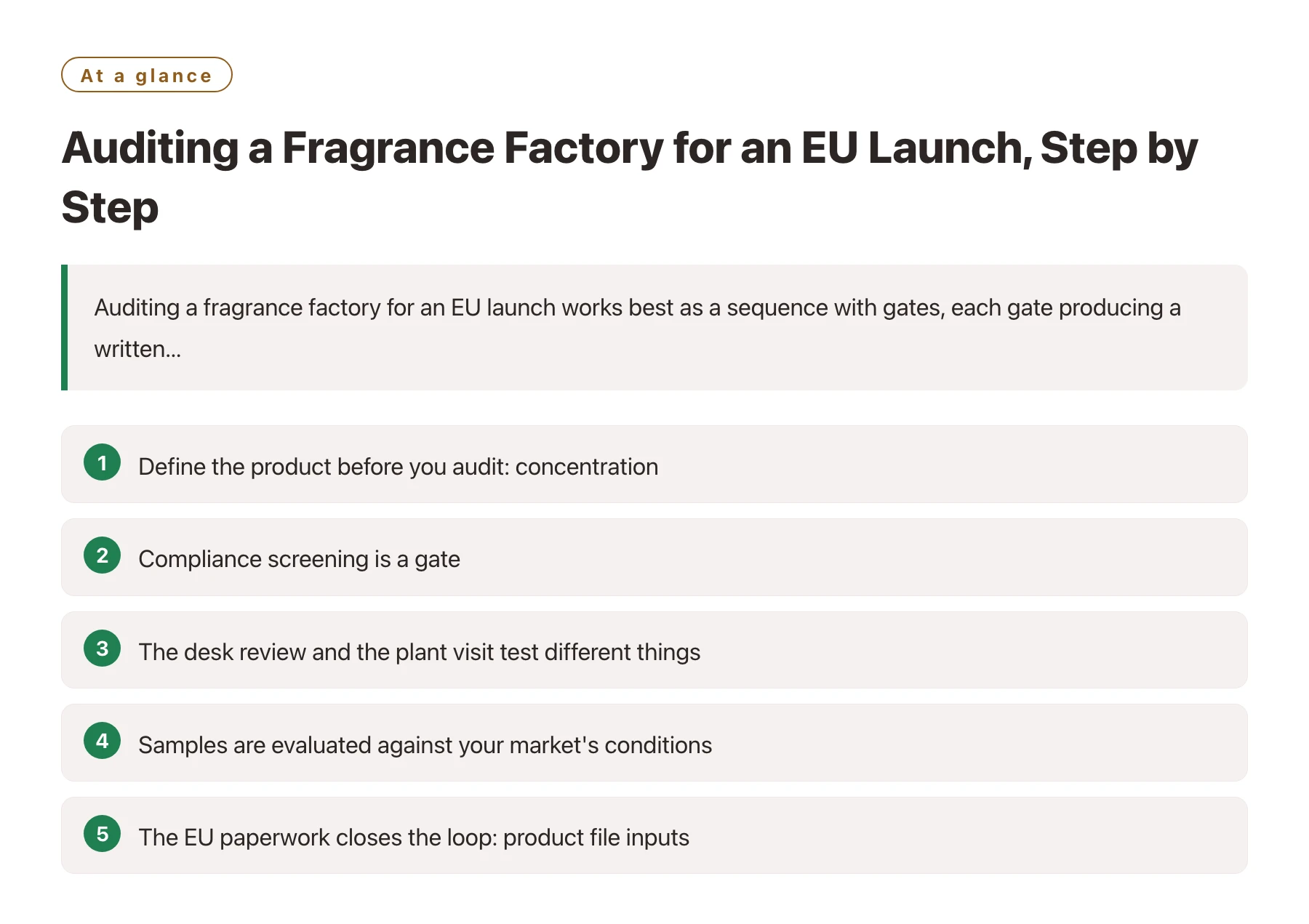
Key takeaways
- Define the product before you audit: concentration, pack format, target markets and launch window decide which documents and tests matter.
- Compliance screening is a gate, not a task: formula data, allergen load and restricted substances are checked before sampling, not after.
- The desk review and the plant visit test different things, documentation against process, and both are needed.
- Samples are evaluated against your market's conditions, and the approved sample becomes a retained reference, not a memory.
- The EU paperwork closes the loop: product file inputs, notification and retained samples are all verified before the first sale.
Most factory audits fail not because the factory is bad, but because the process was loose: the buyer evaluated a plant before the product was defined, and the two never matched. A step-by-step audit fixes that by making every stage a gate with a written decision.
The sequence below is written for an EU-bound launch, but the logic, define, screen, verify, sample, pilot, document, transfers to any regulated market.
The seven steps of a practical audit
- Fix the product definitionWrite the product down: concentration, format, volume, pack materials, target markets and launch window. Nothing downstream can be checked against a moving target.
- Run the compliance screeningCheck the formula direction against the EU essentials: fragrance allergens, restricted substances and the IFRA limits that govern fragrance ingredients. The European Commission's cosmetics pages describe what a product must satisfy [1], and this screen tells you whether the concept can even get there.
- Do the desk reviewRequest the document pack before visiting: certifications with scope lines, a sample batch record, an example allergen declaration, reference shipments. Read it for gaps, then visit with specific questions.
- Walk the plantFollow the product's path, compounding, ageing, filling, decoration, packing, and watch for hygiene, order and documentation at each step. Ask to see a batch record in the room where it is written, not in the meeting room.
- Evaluate samples under your conditionsTest the samples on skin, over hours, across the temperature range of the season you will launch. Keep the approved sample as a sealed, dated, numbered reference.
- Run a pilot or first order with gatesSet the pass criteria before the run: fill tolerance, decorated-sample match, document completeness. The first order proves process, not just product, and a GMP framework such as ISO 22716 is precisely the discipline that makes those proofs repeatable [2].
- Close the EU loopVerify the product file inputs, arrange notification through the CPNP portal, and confirm that retained samples exist for the batch. Nothing ships to market before this loop closes.
Where the process usually stalls
Three stalls account for most schedule damage, and all three are visible in advance. In practice, an audit of a contract manufacturer for perfume brands follows the same gates whether the product is a body mist or an extrait, because the sequence is about the process, not the format.
The sampling loop
Each revision round costs two or three weeks of calendar even when the lab works fast, because batches, wear tests and documentation follow sequentially. Agree on a revision budget in the development proposal and hold it.
Stability versus the calendar
Stability is measured in months and cannot be compressed with a fee. If the launch window does not fit the stability programme, change the plan early. Choosing the packaging and finalising the formula before the stability clock starts is the single biggest lever a buyer has.
Documentation as an afterthought
Factories that export to regulated markets keep the document pack current as a habit; factories that treat it as an event produce it late and incomplete. Ask to see the date stamps on a recent pack, and the pattern shows itself.
What the audit should leave you with
The output is a written file: the product definition, the screening result, the gap list from the desk review, the sample approval reference and the pilot criteria. That file is the seed of your EU product documentation, and it transfers cleanly to any factory.
The audit itself is faster when the factory already runs as a documented, one-stop operation. Start with suppliers that publish their scope, this Guangzhou fragrance house lists its certifications and services outright, so your desk review has something concrete to verify before you travel.
And because the model often lands somewhere between full OEM and full ODM, choose a manufacturer that supports OEM and ODM so the decision can be made per product rather than per partnership. Flexibility at that level is itself a form of capability.
Sources
- European Commission: Cosmetic Products — Specific Topics —— EU pages covering specific cosmetics topics such as product claims, nanomaterials and animal-testing rules.
- ISO 22716 (Cosmetics GMP)
Frequently asked questions
How long should a step-by-step audit take?
A focused desktop review plus a half-day plant visit is usually enough for a first gate. The full sequence, through sample evaluation and a first order, spreads across your development timeline rather than a single trip.
Can I audit before the product is defined?
You can assess general capability, scope, hygiene and certifications, but the compliance and stability gates need a product definition. Do the general audit once, then repeat the product-specific parts per launch.
Who should attend the plant walk?
Ideally the person who will run your account plus the lab or production lead. The account manager sells; the production lead knows where the records live.
What is the minimum sample quantity to evaluate?
Enough for wear tests over several days plus a sealed reference you keep. Agree the quantity with the factory so the evaluation does not stall waiting for the next batch.
Should I repeat the audit for a second product or a second market?
The general checks stand; the compliance and stability gates must be repeated because they are product-specific. A new market can also change the allergen and packaging work.
Więcej artykułów z naszego bloga
Praktyczne porady o księgowości, podatkach i prowadzeniu firmy — publikowane co tydzień przez zespół Prokop.
Wróć na stronę główną