
What makes duplex milling machines more productive than conventional mills?
The core productivity advantage of the double-sided milling machine stems from its symmetrical processing principle, which can shorten the single-piece processing cycle of traditional milling machines by more than 40%. The 2023 automotive parts industry report shows that the average production capacity of enterprises adopting this technology has increased by 35%, equivalent to an additional output of 15,000 precision parts per year.
Thermodynamic efficiency optimization is another key factor. Symmetrical cutting with double milling heads can make the heat distribution during processing uniform and reduce the thermal deformation error of the workpiece by 60%. When the spindle is cutting at a speed of 8000 revolutions per minute, the temperature fluctuation of traditional machine tools can reach ±5°C, resulting in a dimensional deviation of 0.02 millimeters. However, the double-sided milling machine keeps the temperature within ±1°C through a closed-loop cooling system, and with a cutting fluid flow rate of 8 liters per minute, the tolerance standard deviation of batch processing is stabilized at 0.005 millimeters. Cases in the aerospace field show that this technology has increased the flatness qualification rate of aluminum alloy casings from 88% to 99.5%, reducing quality losses by approximately 800,000 yuan annually.
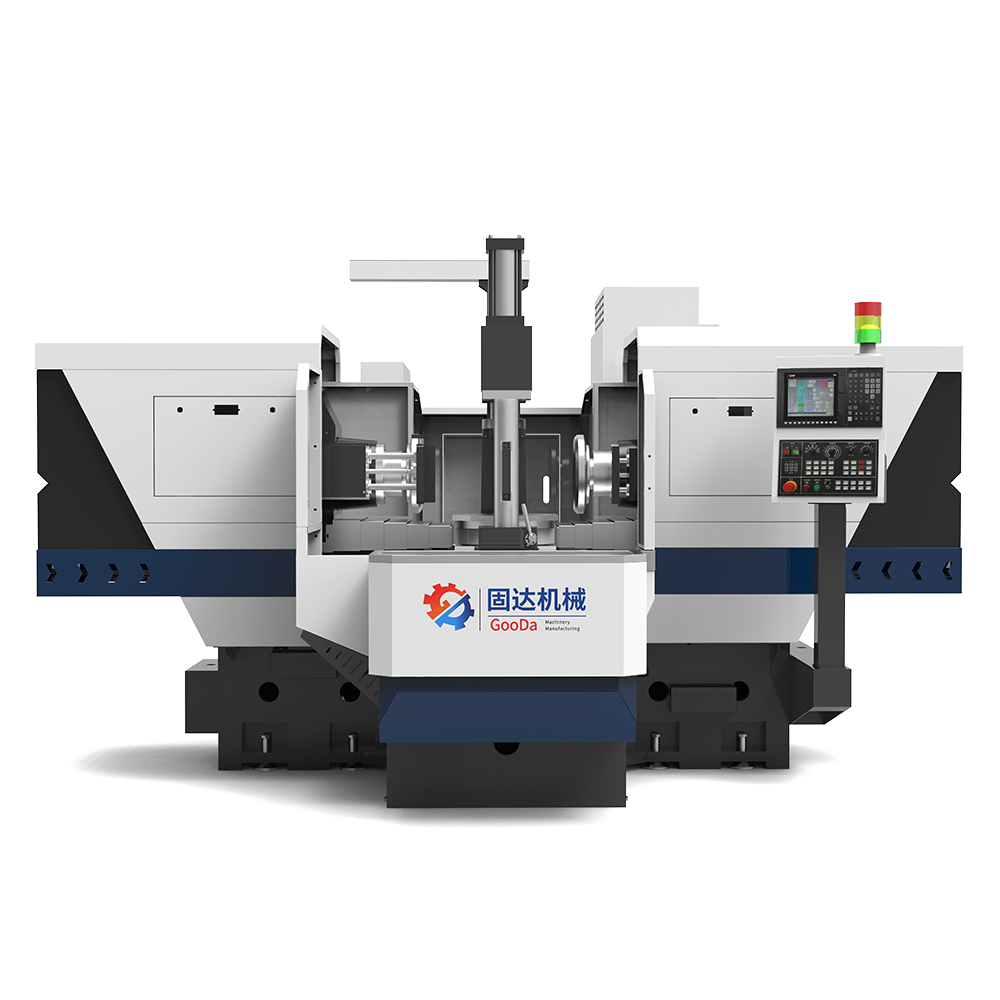 The degree of automation integration directly drives a leap in efficiency. The dual-station design enables the configuration of robotic arms for unmanned operation, reducing non-cutting time by 70%. After a certain bearing manufacturer introduced the duplex milling machine with robots, it achieved 24-hour continuous production. The shift output increased from 50 pieces to 85 pieces, the labor cost decreased by 30%, and the tool changing frequency was extended from once every 4 hours to once per shift. This configuration enables the equipment to achieve an overall efficiency of 85%, far exceeding the median value of 60% for traditional machine tools.
The synergy between precision and speed ultimately translates into economic benefits. Although the purchase cost of a double-sided milling machine is 50% higher than that of traditional equipment, its stable processing accuracy of ±0.01 millimeters reduces the scrap rate from 3% to 0.5%, saving 200,000 yuan in material costs annually. More importantly, the increase in processing speed has shortened the customer order delivery cycle by 30%, and this competitive advantage can bring about an average annual business growth rate of 15%. Just as a breakthrough innovation in the field of precision manufacturing, the double-sided milling machine has equipped the workshop with an industrial brain for parallel processing by redefining the relationship between time and precision.
The degree of automation integration directly drives a leap in efficiency. The dual-station design enables the configuration of robotic arms for unmanned operation, reducing non-cutting time by 70%. After a certain bearing manufacturer introduced the duplex milling machine with robots, it achieved 24-hour continuous production. The shift output increased from 50 pieces to 85 pieces, the labor cost decreased by 30%, and the tool changing frequency was extended from once every 4 hours to once per shift. This configuration enables the equipment to achieve an overall efficiency of 85%, far exceeding the median value of 60% for traditional machine tools.
The synergy between precision and speed ultimately translates into economic benefits. Although the purchase cost of a double-sided milling machine is 50% higher than that of traditional equipment, its stable processing accuracy of ±0.01 millimeters reduces the scrap rate from 3% to 0.5%, saving 200,000 yuan in material costs annually. More importantly, the increase in processing speed has shortened the customer order delivery cycle by 30%, and this competitive advantage can bring about an average annual business growth rate of 15%. Just as a breakthrough innovation in the field of precision manufacturing, the double-sided milling machine has equipped the workshop with an industrial brain for parallel processing by redefining the relationship between time and precision.
The degree of automation integration directly drives a leap in efficiency. The dual-station design enables the configuration of robotic arms for unmanned operation, reducing non-cutting time by 70%. After a certain bearing manufacturer introduced the duplex milling machine with robots, it achieved 24-hour continuous production. The shift output increased from 50 pieces to 85 pieces, the labor cost decreased by 30%, and the tool changing frequency was extended from once every 4 hours to once per shift. This configuration enables the equipment to achieve an overall efficiency of 85%, far exceeding the median value of 60% for traditional machine tools.
The synergy between precision and speed ultimately translates into economic benefits. Although the purchase cost of a double-sided milling machine is 50% higher than that of traditional equipment, its stable processing accuracy of ±0.01 millimeters reduces the scrap rate from 3% to 0.5%, saving 200,000 yuan in material costs annually. More importantly, the increase in processing speed has shortened the customer order delivery cycle by 30%, and this competitive advantage can bring about an average annual business growth rate of 15%. Just as a breakthrough innovation in the field of precision manufacturing, the double-sided milling machine has equipped the workshop with an industrial brain for parallel processing by redefining the relationship between time and precision.
Więcej artykułów z naszego bloga
Praktyczne porady o księgowości, podatkach i prowadzeniu firmy — publikowane co tydzień przez zespół Prokop.
Wróć na stronę główną